
When to increase Amazon bids on tentpole days: hold at base until 3 a.m. PT, then increase multipliers. PBDD data: 49% of day one's ad sales came before noon.
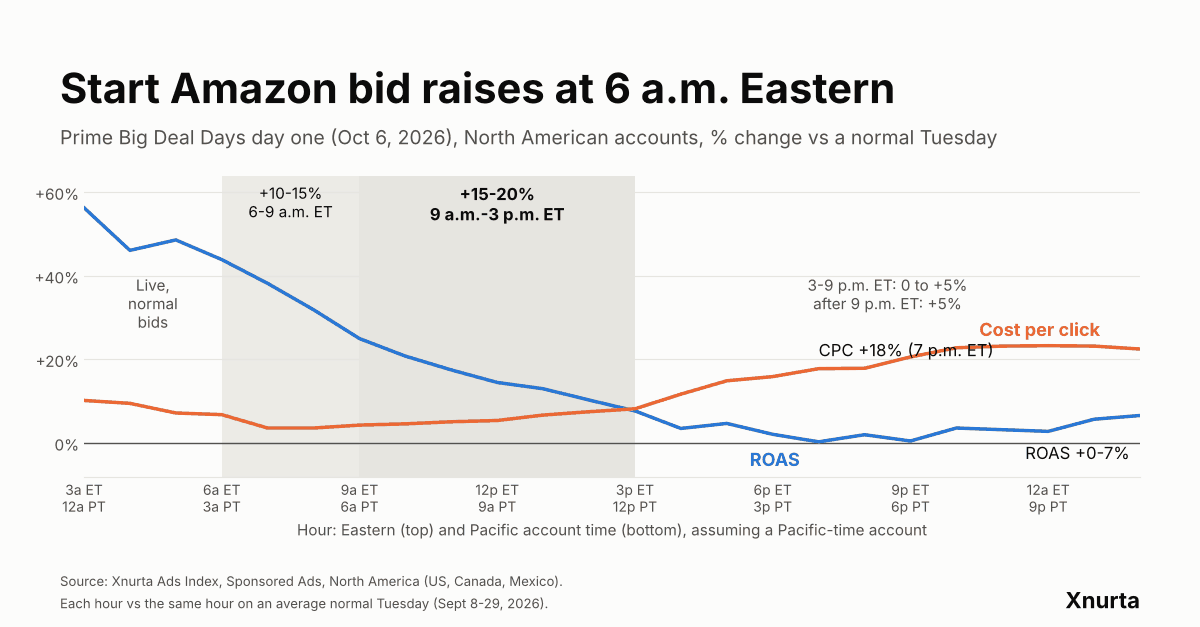
Increase your Amazon bid multipliers from 3 a.m. Pacific on tentpole days like Prime Big Deal Days (PBDD) and hold bids at base until then, because people shop earlier than most ad plans assume. At PBDD on October 6 to 7, 2026, ad sales across the Xnurta Ads Index ran about 2.5 times a normal day. Clicks cost 18% more and most advertisers still improved ACOS, because shoppers arrived ready to buy: conversion and order values rose faster than click prices. The typical advertiser cut ACOS by about 5%. The biggest gains were captured in the morning.
Bid day-parting, also called dayparting, changes your bids by hour on a schedule, with a bid multiplier applied to your base bid in each block. Our view: events are now won hour by hour, and most plans are still set by the day.
The figures come from the Prime Big Deal Days 2026 Benchmark Report and its North American hourly data (all times PT): anonymized advertisers on Xnurta, each hour compared with the same hour on an average normal Tuesday in September.
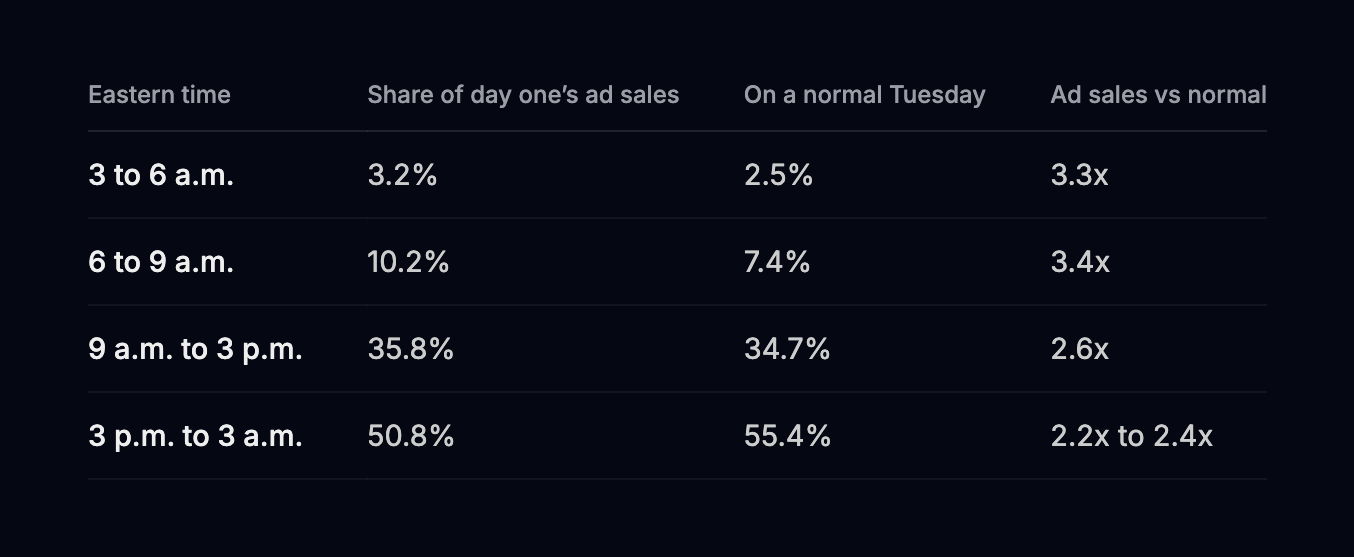
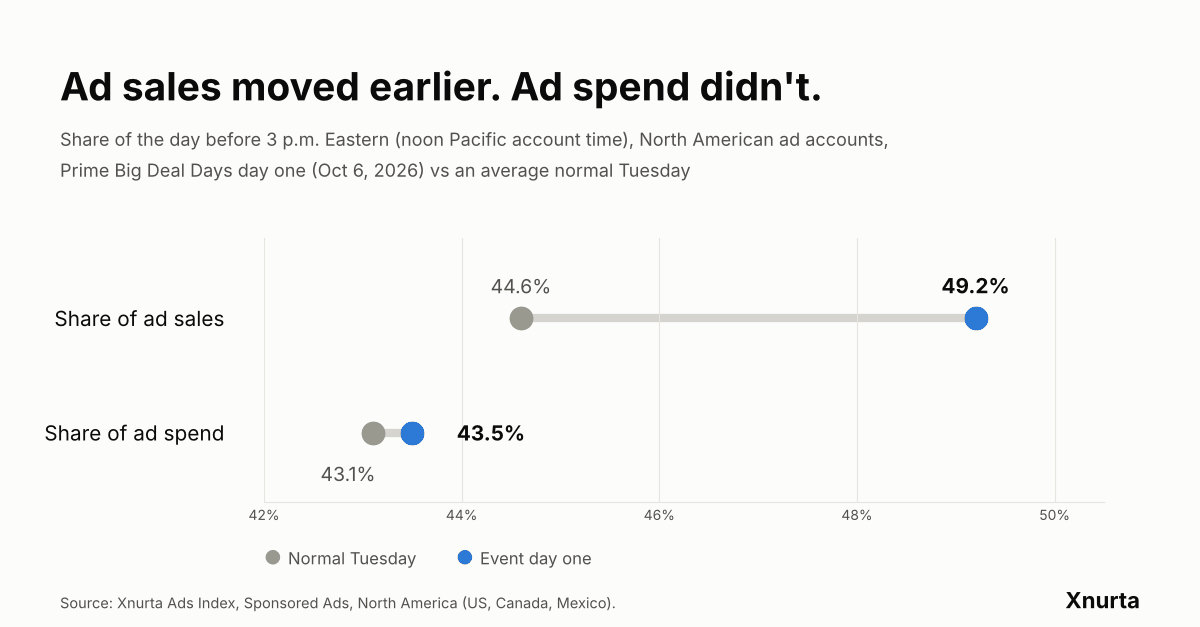
North American ad accounts made 49% of day one's ad sales before noon PT, against 45% on a normal Tuesday. Most of that shift landed before 6 a.m.
Europe suggests this isn't a time-zone quirk. There, accounts and shoppers share a clock, and midnight to 6 a.m. local time rose from 6% to 11% of the day at ROAS about 65% above normal. The early start began a day before, too. Across the Index, ad sales ran about 15% above normal on October 5, and about 30% above in Europe.
Spend didn't follow. North American advertisers put 43.5% of the day's spend into the hours before noon PT, against 43.1% on a normal Tuesday. Sales moved up the clock by nearly five points. Budgets barely moved.
Why so early? Amazon dropped its Today's Big Deals at midnight, 8 a.m. and 1 p.m. PT, most at "Amazon's lowest prices of the year so far" and "available only while supplies last" (Amazon's Prime Big Deal Days announcement). A likely reason: shoppers who wanted a limited deal bought before it sold out, and the first drop landed at the stroke of midnight.
The early hours paid best: in North America, ROAS ran 51% above normal from midnight to 3 a.m. PT and 36% above from 3 to 6 a.m., while click prices rose 9% and 4%.
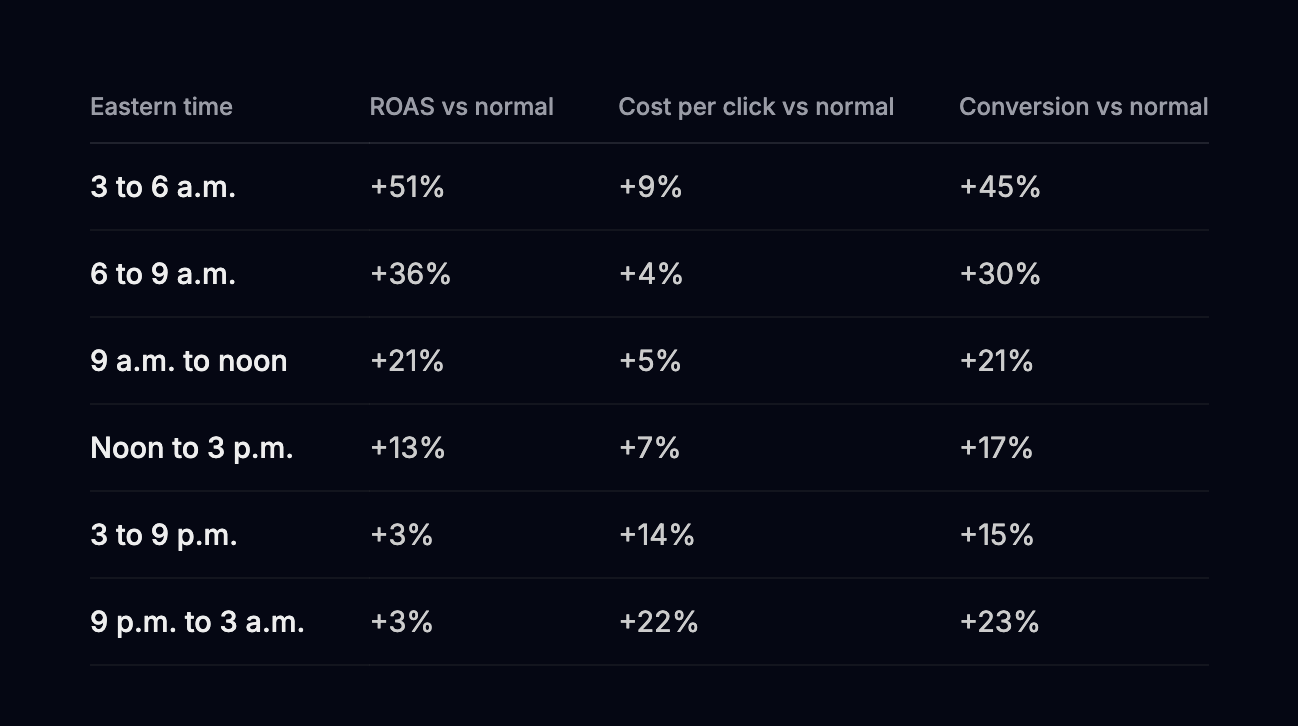
Shoppers kept converting above normal all day. What changed was the price of the click, which climbed through the afternoon and by evening took almost all of the extra return. Our reading, from spend share rather than bid data: sales moved earlier while many advertisers kept bidding for the afternoon and evening. Two other explanations fit. The 1 p.m. PT deal drop may have added afternoon competition, and "dynamic bids - up and down" raises bids automatically when Amazon predicts higher conversion, which evening conversion (23% above normal) would trigger. Your own bid history settles it.
Placement mattered too. Product pages returned 20% more on a 16% rise in click price, while top of search held ROAS roughly level on clicks that cost 21% more. And October was a real event, not a warm-up: against July's Prime Day, clicks cost 14% less and ROAS held.
Not in October: over a two-day event, day one paid more than day two, and the first 12 hours beat every later stretch.
A common view says day 1 is for researchers and buyers come back on day 3 or 4. That may hold over four days in July. Over October's two days it didn't. Across the Index, day one's ROAS ran about 15% above normal and day two's about 4%, and midnight to noon on day one beat everything after it. If your plan assumes the serious buyers show up late, your biggest bid multipliers land in the wrong hours. Match the plan to the event's length. On a short event, treat the morning like day one.
Hold bids at base from midnight PT, increase multipliers from 3 a.m., and set the largest from 6 a.m. to noon.
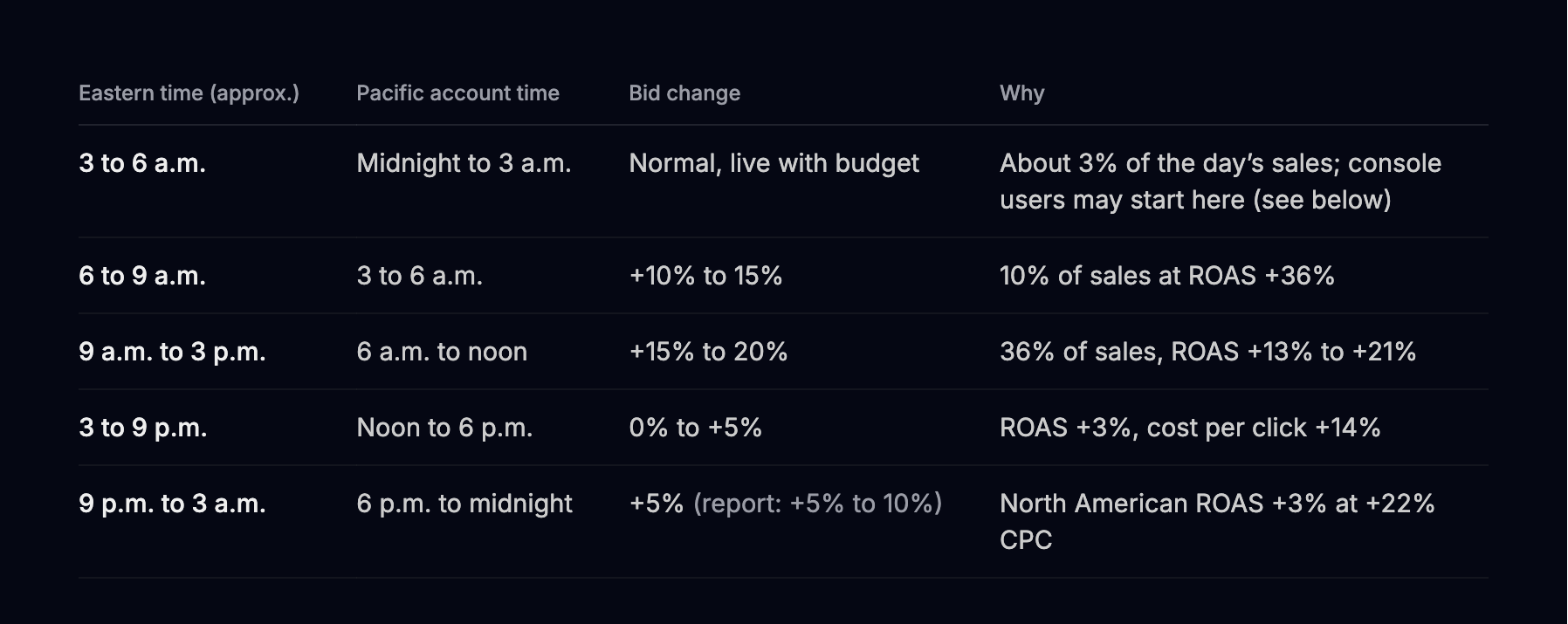
Midnight to 3 a.m. returned the most per dollar but carried only about 3% of the day's sales, so a multiplier there buys little. Stay live at base bids and hold the multiplier until 3 a.m. For North America we'd keep the evening at the low end, because the extra return there was thin.
Why is the biggest multiplier at 6 a.m. and not 3 a.m.? Both blocks returned well above normal on modest click prices. From 3 to 6 a.m. each click earned the most of any block with real volume, so a multiplier there carries the least risk. From 6 a.m. to noon, ROAS still ran 13% to 21% above normal at click prices only 5% to 7% higher, and that block held 36% of the day's sales against 10%. More volume earns more budget and the bigger multiplier. These are average returns, and extra spend earns less than the average, so keep multipliers modest and run the breakeven check below.
The next event may not follow October's exact shape. Check its first day's hours before its biggest day, and test the schedule on one marketplace first.
On a $1.00 base bid, run 1.12x at 3 a.m., 1.18x at 6 a.m. and 1.05x at noon and again at 6 p.m. PT, then return to 1.00x at midnight.
The example comes from the report: a US campaign on proven terms with a normal ROAS of 5.0 (a 20% ACOS account), a $1,000 daily budget and a 25% margin after discounts. Put the cap on the combined bid at 1.5x base, so $1.50 here, with a top-of-search adjustment no higher than +25%. At +15% on a hero product or brand term, the peak is $1.18 x 1.15 = $1.36. Product pages returned more than top of search, so keep the top-of-search adjustment for the terms that earn it.
The bidding strategy decides whether your cap holds. "Fixed bids" and "dynamic bids - down only" keep it. "Dynamic bids - up and down" can raise top-of-search bids by up to 100% and other placements by up to 50%, so it can blow straight through.
Add budget at noon PT only while the morning's ROAS stays above breakeven plus a buffer. Same-day sales read low, so err toward stopping.
For the example campaign, raise the day's budget to about $2,000, the report's US advice (US ad sales ran 2.2 times normal, at ROAS 8% above normal). Then check at noon. North American spend by noon was 43.5% of the day against 49% of sales, so spend trailed sales. If you've spent past 60% of the budget ($1,200), raise it again only while the morning's ROAS stays above 5.0, which is breakeven (4.0 at a 25% margin) plus a cushion.
The breakeven test is simple. Breakeven ROAS is 1 divided by your margin after discounts. Say the first $1,000 returns $6,000 and the full $2,000 returns $11,000. The extra $1,000 brought back 5.0, so it cleared 4.0. Stop adding when the extra money returns less than that.
And judge the event on more than ROAS. New-to-brand sales ran at about 1 in 10 of ad sales for brand-registered advertisers, and in North America total sales grew faster than ad sales. Ads carried about half of event sales, against about 60% on a normal day.
Return every bid multiplier to 1.00x at midnight PT when the event day ends, then go after the new customers it brought in.
Reach the event's new-to-brand buyers afterwards with Sponsored Display purchase remarketing or an Amazon Marketing Cloud audience, not the general mix. They already showed you they'd buy.
Then expect a dip. After October's event, conversion read 20% to 30% lower on October 8 and 9 while click prices went straight back to normal, so ROAS read 0.7 to 0.8 times normal for two days. Many shoppers had likely bought ahead. Treat it as an early read, since those days had the least time to collect attributed sales. Approve the return to normal bids before the event starts, and lower bids 10% to 20% only where your own two days after fell below breakeven.
For Sponsored Products, enter the schedule as schedule-based bid rules in the console or Ads API, one rule per time block.
Amazon introduced schedule-based bid rules for Sponsored Products in November 2023. They increase bids at set hours, days or date ranges, and event-based bid rules later added predefined increases for high-traffic events. Before you rely on them for the full schedule, confirm three things in your account: that the increase can match your multiplier, which time zone the rule runs on, and how it works with your bidding strategy. Amazon's announcements don't cover Sponsored Brands or Sponsored Display.
Where the native rules can't match your blocks, two bulk uploads approximate the schedule. It goes live around 11:30 p.m. PT instead of 3 a.m., which trades about three and a half low-volume hours for one upload.
With many accounts, start with the ones that make up most of your event spend.
By hand, the full schedule is about 8 bid changes per campaign per marketplace across a two-day event. In an Xnurta AI Managed Group you approve one dated event schedule once. Hourly bids then run on AI inside the range you set, on your own rule, or by hand, and every change is logged.
Check whether your October 6 bid multipliers had increased by 3 a.m. PT. If not, you missed part of the hours that paired volume with return. Your campaign change history in the console shows when bids moved.
Then compare your October 6 to 7 ACOS with your September 6 to October 5 average, running the report seven or more days after the event (14 for vendors). On an account that normally runs a 20% ACOS, the best 25% of advertisers finished near 14% or better, the typical advertiser near 19%, and the bottom 25% at 23% or worse. Category explains part of the spread, so read it as variation, not cause.
Black Friday Week has more than one peak morning, and the days between them don't pay the same. We'll publish that plan soon. Until then, one question: will your bid multipliers be up by 3 a.m. PT?
Get the full Prime Big Deal Days 2026 Benchmark Report for placements, markets, categories and the complete hourly schedule. Want it set up on your account? Book a demo, bring one account (or one client) and one marketplace, keep your rules where you want them, and we'll compare your October 6 hours with this curve and build the 3 a.m. plan from where you landed.
About the data: the Xnurta Ads Index is anonymized, aggregated Sponsored Products, Sponsored Brands and Sponsored Display data from advertisers on Xnurta, who run each lever on Xnurta's AI, their own rules or by hand, so it can differ from the whole market. Event-wide figures cover North America and Europe. Hourly figures cover North America (US, Canada, Mexico), are pooled in dollars, appear in Pacific time, and compare each hour with the same hour on an average normal Tuesday in September (Wednesday for day two). The Europe figure is in each account's local time. Attributed ROAS excludes discount cost and organic lift. Data was pulled October 10, before every attribution window closed, so event-day figures may still rise slightly and the days after may shift. We don't publish advertiser counts or spend totals, and figures are rounded. May be shared with attribution. Amazon, Amazon Ads and Prime Big Deal Days are trademarks of Amazon; this is Xnurta's independent analysis, not endorsed by Amazon.
Bid day parting is a schedule that changes your Amazon ad bids by hour of day. Each block of the schedule gets a bid multiplier, such as 1.15x, applied to your base bid until the block ends.
A bid multiplier is the number you multiply your base bid by during a time block. At a $1.00 base bid, a 1.15x multiplier bids $1.15. Placement adjustments, such as top of search, stack on top of it.
Hold bids at base 1.00x until 3 a.m. PT, then increase multipliers. In October, 3 to 6 a.m. PT returned ROAS 36% above normal on clicks 4% more expensive, and 6 a.m. to noon held the most volume.
Yes. Cap the combined bid at 1.5x your base bid. "Fixed bids" and "dynamic bids - down only" keep the cap, while "dynamic bids - up and down" can raise top-of-search bids up to 100% and other placements up to 50%.
At midnight PT, when the event day ends. After October's event, ROAS read 0.7 to 0.8 times normal for two days, so approve the return to normal bids before the event starts.
Yes, for Sponsored Products. Amazon's schedule-based and event-based bid rules increase bids at set hours, in the console or Ads API. Confirm the increase limits, time zone and bidding-strategy behavior in your account, and use a bid tool or timed bulk uploads for the rest.
No fluff. Just what's working.