
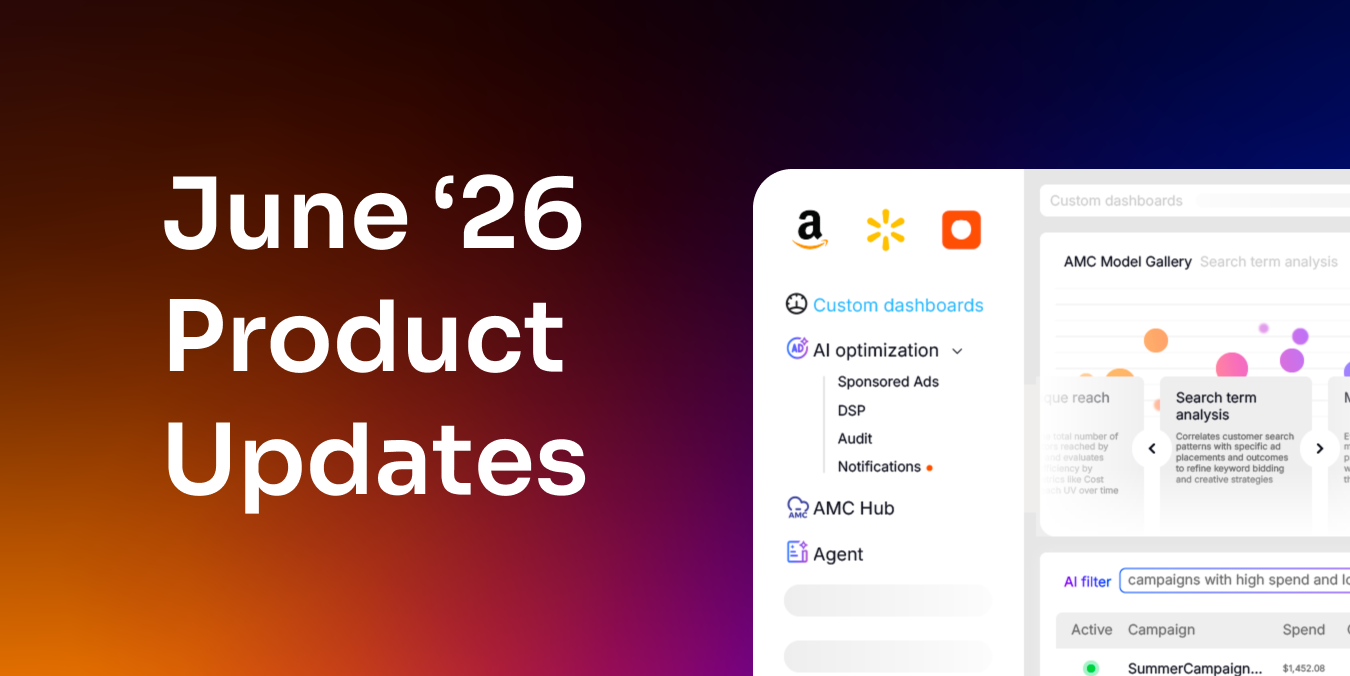
Explore seven Xnurta updates from June, including Custom Metrics, ROAS Priority Mode, AMC 1P Data uploads, and expanded DSP and marketplace support.
Key takeaways
More control over reporting and spend, smarter audience workflows, and broader DSP and marketplace coverage.
June gave Amazon advertisers more control over reporting and bid efficiency while making it easier to turn audience data into action. Four featured releases lead this month's roundup, alongside three additional platform updates. Availability varies by feature.
Your team does not run the business on ROAS and ACOS alone. Agencies and brands often use client-specific TACoS definitions, tROAS formulas, or promoted-product conversion rates that have traditionally lived in separate spreadsheets.
Custom Metrics lets you build recurring calculations inside Customized Dashboard using existing reporting fields and basic arithmetic. Once saved, a metric can be reused in tables and charts for the relevant account and ad type, reducing repeated exports and helping each team keep its reporting logic consistent.
Available now in Customized Dashboard.
When a stable Managed Group is meaningfully below its ROAS target, regular optimization can feel too gradual. ROAS Priority Mode adds a stricter cost-control setting under Optimize Base Bids while keeping regular AI optimization active.
When performance has clearly deviated from the target and the data is sufficient, the system is more likely to lower base bids or keep them unchanged instead of continuing upward exploration. The setting affects base-bid optimization only; it does not change targeting, budgets, or structure optimization, and Auto Pacing takes priority while active. It is best suited to mature, ROAS-sensitive Managed Groups rather than new-product or aggressive-growth campaigns.
Limited rollout. Contact your Customer Success Manager to confirm access.
Promotion pacing and low-conversion hours often force teams into repetitive portfolio-budget changes. Portfolio Budget Dayparting lets advertisers configure fixed hourly budgets and apply a baseline budget during unconfigured periods. One template can link to multiple eligible portfolios, and portfolio-level control can span Sponsored Products, Sponsored Brands, and Sponsored Display campaigns.
The system runs at each full hour, so changes take effect from the next full hour rather than in real time. The feature runs only for eligible, active Date Range Budget portfolios. Teams can set lower fixed budgets during low-value periods while keeping campaigns online, then increase the budget around promotion peaks.
Permission-based Beta. Contact your Customer Success Manager to confirm access.
CRM lists, member tiers, website purchases, app events, and offline transactions do not automatically follow customers into Amazon Marketing Cloud. AMC 1P Data Upload closes that gap by bringing owned customer signals into AMC Hub.
Operators can upload a CSV dataset, map identity and event fields, review match status, analyze matched users in supported AMC models, and create first-party or lookalike audiences for activation. Static and event datasets have different requirements, and not every dataset type works with every AMC model or action.
Available in AMC Hub as of June 30, 2026.
The through line: less spreadsheet work, fewer manual budget checks, faster activation of owned audience data, and broader control across DSP and international marketplace workflows.
In July, Amazon Business Bid Adjustment is in Beta as an independent AI action space for Sponsored Products. Advertisers can set a 0% to 900% range, and AI can compare Amazon Business traffic with regular traffic while keeping every adjustment inside the user-defined bounds. Sponsored Brands and Sponsored Display are not supported in this release and may be evaluated based on Beta feedback.
July Beta. Contact your Customer Success Manager to request access.
Questions about which June updates are available for your account, or where a new control fits into your current workflow? Contact your Customer Success Manager for eligibility, setup guidance, and rollout details.
No fluff. Just what's working.