
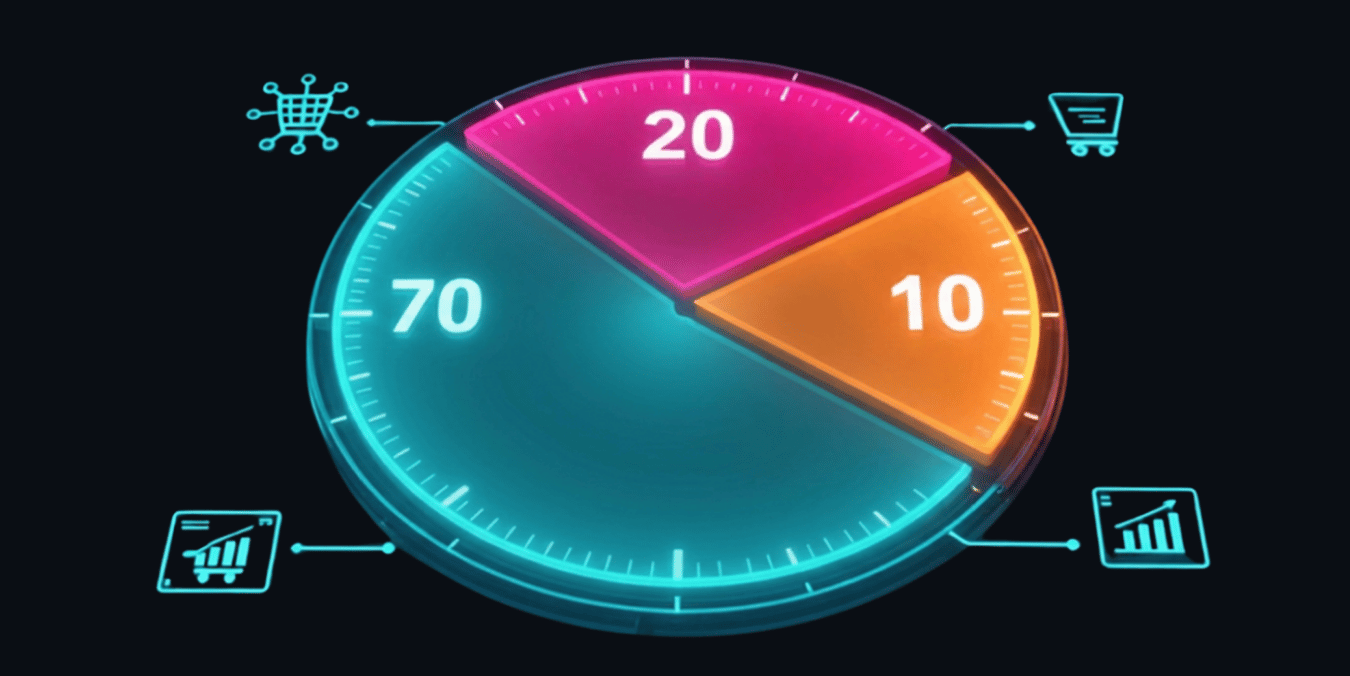
The 70/20/10 framework gives retail media teams a principled way to allocate budget across proven tactics, scaling tests, and AI experimentation — without gambling core performance.
Key takeaways
New AI tools are multiplying. Budgets aren't. Here's how the best retail media teams decide what to fund, what to scale, and what to test.
Every retail media team is having some version of the same conversation right now: generative AI is producing creative faster and cheaper than ever. Amazon Marketing Cloud is unlocking audience intelligence that wasn't accessible twelve months ago. New commerce media networks are pitching first meetings. And the budget hasn't changed.
The question isn't whether to invest in new capabilities. It's how to do it without dismantling what's already working.
At Signal to Scale 2026, Kiri Masters — host of Retail Media Breakfast Club and one of retail media's most respected independent analysts — offered a framework that answers this directly. It's called the 70/20/10 model, and it's both simple enough to remember and rigorous enough to actually drive decisions.
The logic is clean. Split your retail media budget across three buckets:
The beauty of the framework is in the constraint. By defining the experimental bucket as 10%, you give your team permission to test genuinely new things without the risk of over-rotating. And by defining the proven bucket as 70%, you protect the performance baseline that funds everything else.
The AI era in retail media is generating an unusually high volume of legitimate innovation. Amazon Marketing Cloud has matured significantly. Generative AI for creative is producing real efficiency gains. Agentic commerce is changing the shape of the consumer funnel. All of these deserve investment.
But they deserve proportionate investment — structured in a way that doesn't cannibalize what's working while the new capabilities prove themselves. Without a framework like 70/20/10, teams tend to either under-invest in innovation (sticking with proven tactics while the environment shifts) or over-invest in it (chasing shiny new tools at the expense of core ROAS).
Kiri's point is that the framework itself is AI-era-proof. You change what's in each bucket as the landscape evolves — but the structure of 70/20/10 remains a stable operating model regardless of what specific tools or tactics exist.
There's a practical challenge hidden in this framework that's worth naming: you can only execute 70/20/10 well if you know which bucket each tactic belongs in.
That requires measurement. Specifically, the ability to see which campaigns are genuinely driving incremental sales versus recirculating existing customers, which audiences are delivering lift versus wasted spend, and which upper-funnel investments are influencing lower-funnel conversions.
This is exactly what Amazon Marketing Cloud was built for. Without AMC-level visibility, the 70/20/10 framework is an aspiration. With it, it's an operating model.
Xnurta AMC Hub gives your team that visibility — across all 10 pre-built analytics models, updated automatically, without requiring a data analyst or a single line of SQL. It's the infrastructure that makes structured budget allocation possible at the pace retail media requires.
Watch Kiri Masters' full keynote, including the 70/20/10 framework in context.
No fluff. Just what's working.