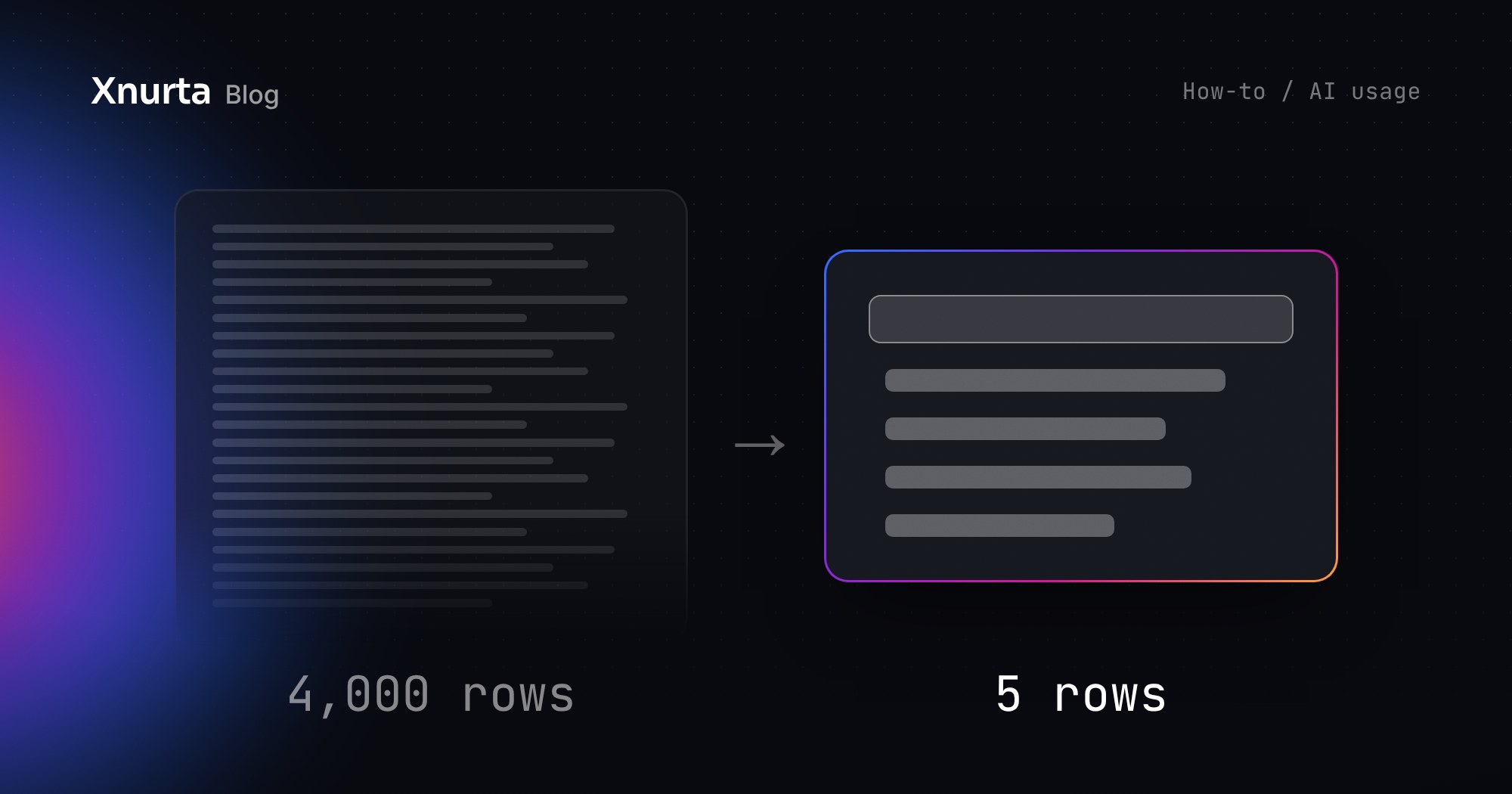

We ran the same 24 Amazon Ads questions through the Amazon Ads MCP server and Xnurta MCP. Xnurta used 16 to 30x fewer tokens per question at the median.
On the same 24 Amazon Ads questions, one route made the AI assistant read 78.1 million input tokens. The other made it read 824,000. That gap decides whether your team's Claude or ChatGPT plan lasts the week, and whether a cross-account review fits in one conversation.
Xnurta is an AI retail media platform for brands and agencies, and Xnurta MCP connects Claude, ChatGPT and other MCP clients to your Xnurta data. MCP (Model Context Protocol) is the open standard that lets an AI assistant connect to a tool like your ad platform. We ran the same 24 questions through the Amazon Ads MCP server and through Xnurta MCP, then counted what each one cost the assistant. This post is for data leads who distrust vendor benchmarks, teams comparing MCPs on running cost, and anyone who funds AI plans.
A token is the unit an AI assistant counts when it reads or writes text. Your Claude or ChatGPT plan is measured in tokens, and so is how much the assistant can hold in one conversation, so more reading per answer means fewer answers per plan. More terms are in the Amazon Ads MCP glossary.
Xnurta MCP used 16 to 30 times fewer tokens per question at the median, and 95 times fewer across the whole batch of 24. We report the conservative end of each range.
Xnurta internal test, October 2026: same 24 questions and wording on both routes, seven AI assistants from the Claude, GPT and GLM families, two rounds. Token figures come from the three assistants with complete logs, at the conservative end of the range. Results vary by account, question and assistant.
Each row measures something different. The two per-question rows count the total tokens the assistant processed for one question. The batch row counts input tokens only, summed over all 24 questions, so 95 times is a batch figure and not a per-question claim. Dividing it by 24 won't give you a number you can set beside the other two rows. The worst single question matters most for big accounts: on Xnurta MCP it stayed under 150k tokens.
The median answer took about 3.4 minutes on Xnurta MCP and about 12.3 on the Amazon Ads MCP server, roughly 3.6 times faster. Response time here is the time from question to finished answer, as timed in the test. On average, answers took 6.0 minutes against 16.8.
Is 3.4 minutes fast? Not instant, because the assistant is still looking things up and writing a finished answer. The gain is in the total. An illustrative weekly review of ten questions takes about 34 minutes at the Xnurta median instead of about two hours.
We asked 24 everyday Amazon Ads questions with identical wording on both routes, across five categories, using seven AI assistants from the Claude, GPT and GLM families. We ran two full rounds. These examples show the kind of question, not the exact test wording.
The gap comes from design. The Amazon Ads MCP server returns API-level data for your agent to process, while Xnurta's agent does the analysis and returns a finished answer. Take a question like this one.
Through the Amazon Ads MCP server, the assistant gathers the data campaign by campaign and day by day, adding each page to the conversation before it can do the math. Through Xnurta MCP, the platform does that work and returns the finished list, with a reason on each row. The assistant reads an answer instead of building one.
Fewer tokens per answer means more answers from the AI plan you already fund. A worst-case question under 150k tokens leaves room for the follow-up, the margin paste and the approved change in the same conversation. Multi-account questions like the one below are where large brands and agencies feel the difference most.
It shows how much an AI assistant reads, and how long it takes, to answer the same questions through two routes today. These are its limits.
Want to see it on your own account? Book a demo and our team will show you Xnurta and Xnurta MCP, and how finished answers keep your AI plan working through the week. Black Friday on November 27 is when your team will ask its AI plan the most questions, so book before then. Xnurta MCP is included in Xnurta plans. Already on Xnurta? Create a read-only connection in the Xnurta platform and try three of your own weekly questions. To compare options first, read how to choose an Amazon Ads MCP.
Sources: Xnurta internal test, October 2026 (method above); Amazon Ads, announcement of the Amazon Ads MCP server (February 2, 2026).
Check before you trust it. We didn't score accuracy in this test, so compare one settled number, 14 or more days old, with the Amazon console in the same attribution window, and ask each answer to state its date range and definitions. Do it on a read-only connection, where nothing can change.
It's a narrow one: tokens and time on 24 everyday questions. The typical question used a fraction of the tokens, so the same AI plan covers more of the week, but Xnurta's own processing isn't in the count, and if you're building a custom agent the Amazon Ads MCP server fits that job better.
A team that runs out of AI plan usage by Wednesday could get through a full week of client reviews on the plan it already pays for (illustrative). Agencies feel it most on cross-client questions: run one connection per client, give juniors read-only access, and keep the weekly routine as a shared Skill.
A token is the unit an AI assistant counts when it reads or writes text. Your Claude or ChatGPT plan limit and the size of one conversation are both measured in tokens.
No fluff. Just what's working.