
Start Amazon bid raises at 6 a.m. Eastern on peak days. On Prime Big Deal Days, 49% of day one’s North American ad sales came before 3 p.m. Eastern.
Start your Amazon bid raises at 6 a.m. Eastern, because people shop earlier than you think. On Prime Big Deal Days (October 6 to 7, 2026), ad sales across the Xnurta Ads Index ran about 2.5 times a normal day, and 56% of advertisers improved ACOS even though clicks cost 18% more (Index-wide; North America 58% improved). The gains sat in the morning. North American accounts made 49% of day one’s ad sales before 3 p.m. Eastern, up from 45% on a normal Tuesday, but put barely more of their spend there. Shoppers arrived ready to buy: conversion and order values outran the higher click prices. Our view: events are now won hour by hour, and most plans are still set by the day.
The figures come from the Prime Big Deal Days 2026 Benchmark Report and its North American hourly data: anonymized advertisers on Xnurta, each hour compared with the same hour on an average normal day.
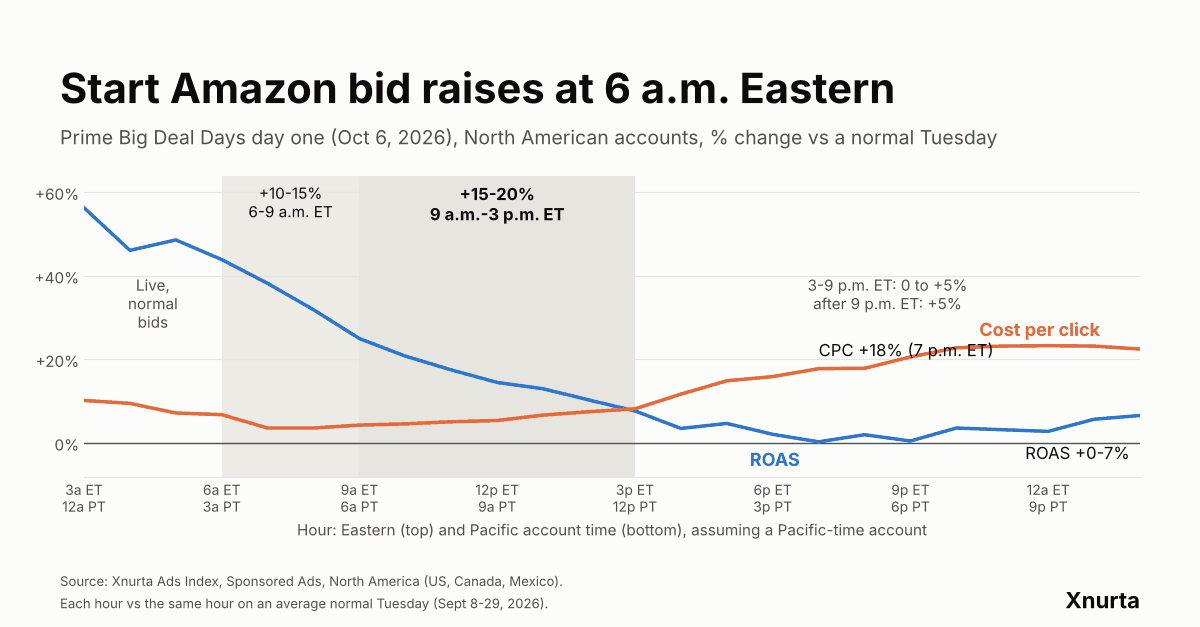
Image file: PBDD26-hero-wide.png · Alt text: Line chart, Prime Big Deal Days day one, North American ad accounts: ROAS ran well above normal before 3 p.m. Eastern while cost per click rose most after it
Prime Big Deal Days shoppers bought earlier than usual: North American accounts made 49% of day one’s ad sales before 3 p.m. Eastern, against 45% on a normal Tuesday, and most of that shift came before 9 a.m. Eastern.
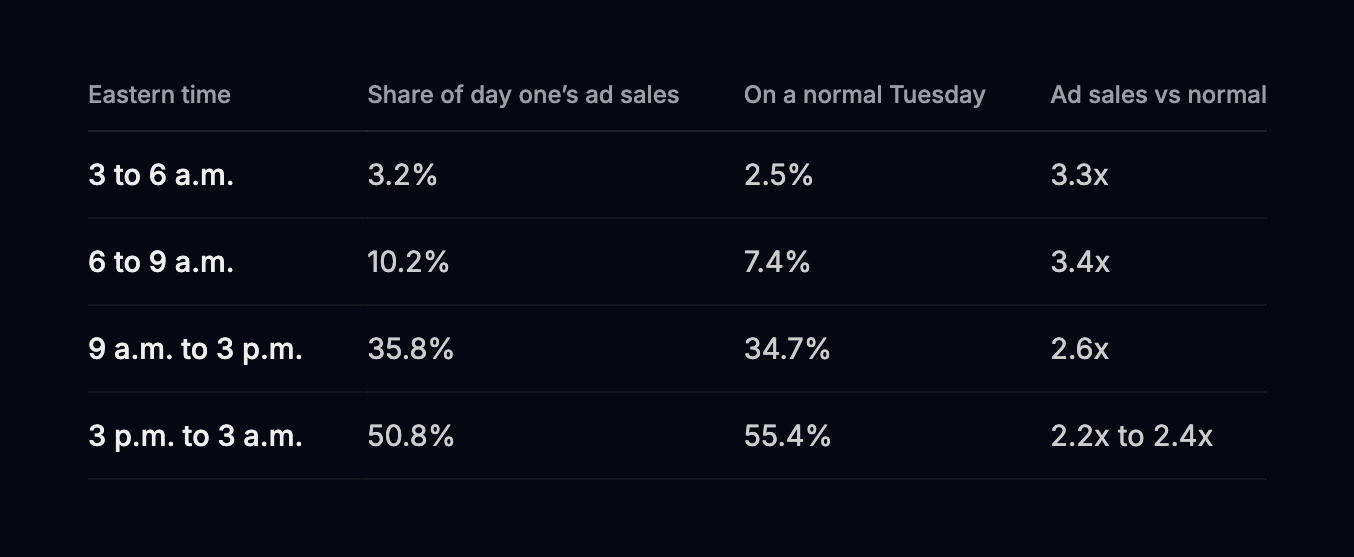
Europe suggests it isn’t a time-zone quirk. In Europe, where accounts and shoppers share a clock, the hours from midnight to 6 a.m. rose from 6% to 11% of the day at ROAS about 65% above normal. And the early start began a day before: across the Index, ad sales ran about 15% above normal on October 5 (North America 11%).
Spend didn’t follow. North American advertisers put 43.5% of the day’s spend into the hours before 3 p.m. Eastern, against 43.1% normally.
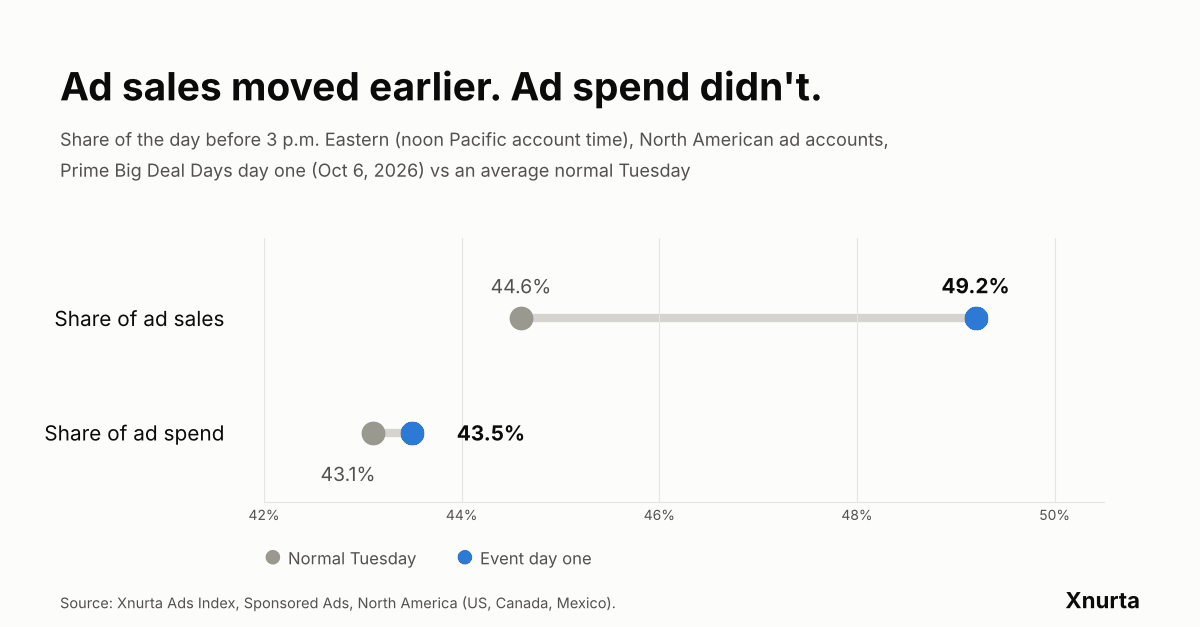
Image file: PBDD26-sales-vs-spend.png · Alt text: Dot chart: before 3 p.m. Eastern on Prime Big Deal Days day one, North American share of ad sales rose from 44.6% to 49.2% while share of ad spend moved from 43.1% to 43.5%
Why so early? Amazon released its Today’s Big Deals at 3 a.m., 11 a.m. and 4 p.m. Eastern, most at its “lowest prices of the year so far” and “available only while supplies last” (About Amazon, Sept 30, 2026). Our reading: shoppers who wanted a limited deal bought before it sold out, and the first drop was waiting when the East Coast woke up.
The early hours paid off: in North America, ROAS ran 36% above normal from 6 to 9 a.m. Eastern and 21% above from 9 a.m. to noon, while cost per click rose only 4% to 5%.
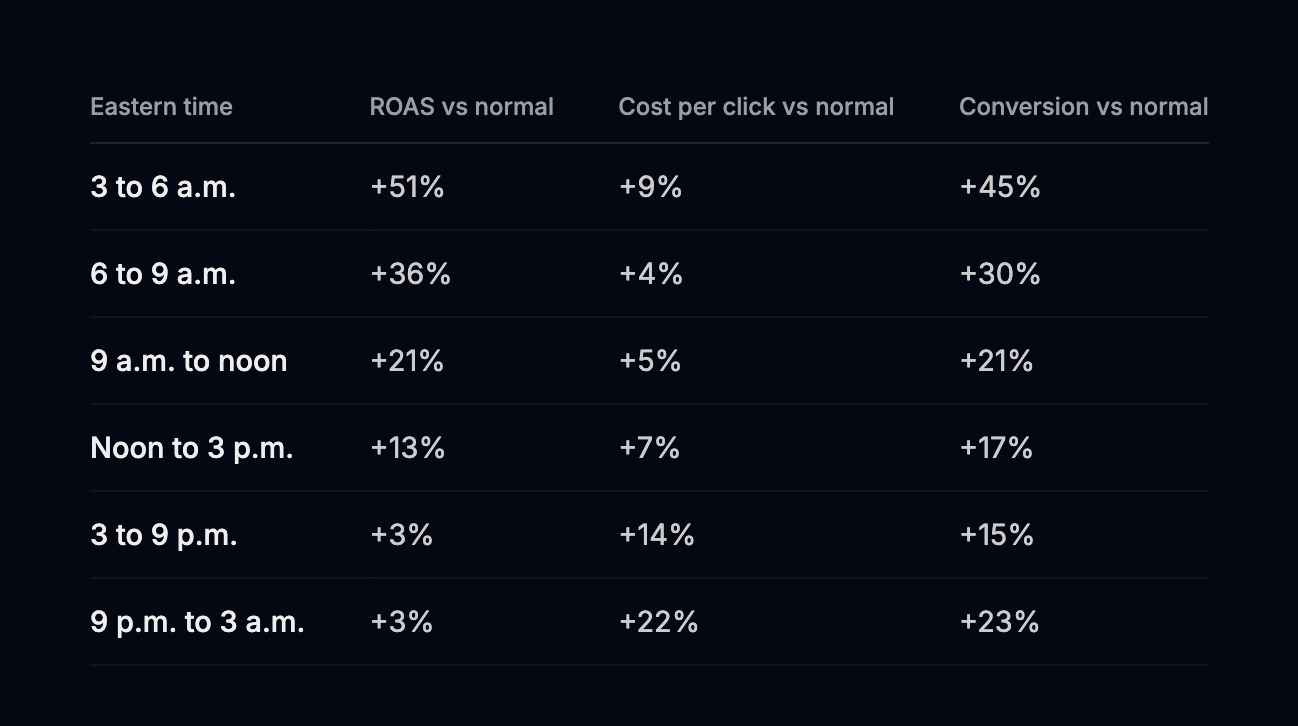
Shoppers kept converting above normal all day. What changed was the price of the click, which rose through the afternoon and by evening took almost all of the extra return. Our reading, from spend share rather than bid data: while sales moved earlier, many advertisers kept bidding for the afternoon and evening. Two other explanations fit too: the 4 p.m. Eastern deal drop may have added afternoon competition, and “dynamic bids – up and down” raises bids automatically when Amazon predicts higher conversion, which evening conversion (+23%) would trigger. Your own bid history is the test.
Two more things the report found. Placement mattered: product pages returned 20% more on 16% higher cost per click, while top of search held ROAS flat on 21% higher cost per click (in North America: +17% and flat, on 16% and 17% higher cost per click). And October was a real event, not a warm-up: against July’s Prime Day, clicks cost 14% less and ROAS held (North America +1%).
Not in October: over a two-day event, day one paid more than day two, and the first 12 hours (3 a.m. to 3 p.m. Eastern) beat every later stretch. A common view is that “day 1 is for researchers; buyers come back on day 3 or 4.” That may hold over four days in July. Across the Index in October, day one’s ROAS ran about 15% above normal and day two’s about 4%. Match the plan to the event’s length: on a single peak day, treat the morning like day one.
Start at 6 a.m. Eastern, make your biggest raise from 9 a.m. to 3 p.m., and keep afternoon and evening raises small. The hours before 6 a.m. Eastern returned the most per dollar but carried about 3% of the day’s sales, so a raise there buys little. Use it on each peak day of your next event, and test it on one marketplace first.
Clock key: Eastern is what you plan by; Pacific is what most US ad accounts report in.
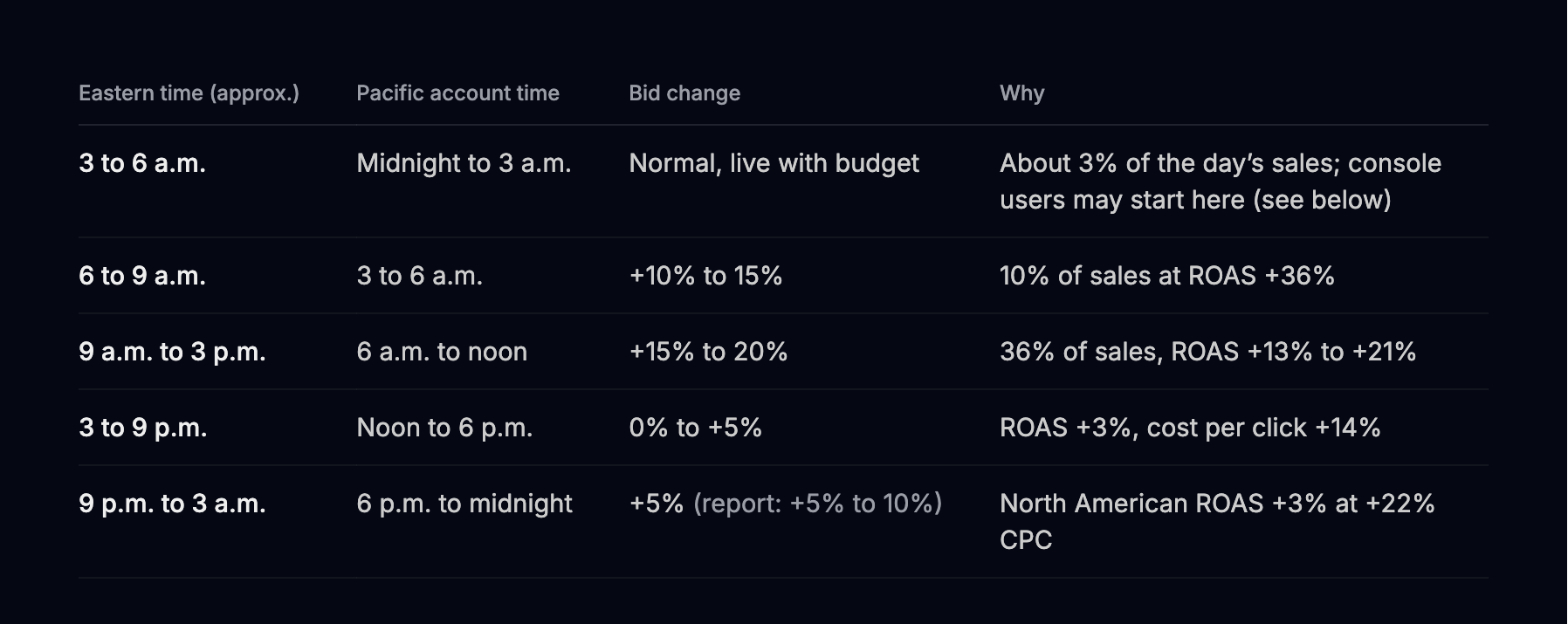
This is the report’s hourly schedule. For North America we’d keep the evening at the low end, because the extra return there was small.
Why is the biggest raise from 9 a.m., not 6 a.m.? Both blocks returned well above normal on modest click prices. From 6 to 9 a.m. Eastern, each click earned the most (ROAS +36% at CPC +4%), so a raise there carries the least risk. From 9 a.m. to 3 p.m., ROAS still ran 13% to 21% above normal at CPC only 5% to 7% higher, and that block held the most volume (36% of the day’s sales against 10%), so it gets the most budget and the larger raise. These are average returns, and extra spend earns less than the average, so keep the raises modest and run the breakeven check. The next event may not follow October’s exact shape, so check its first day’s hours before its biggest day (hourly sales come from Amazon Marketing Stream through an ad tool or the Amazon Ads API; the console shows bid change history but not hourly sales).
On a $1.00 bid: $1.12 at 6 a.m. Eastern, $1.18 at 9 a.m., $1.05 at 3 p.m. and $1.05 at 9 p.m. (the report’s example uses $1.08; we keep North America at the low end), then back to $1.00. The example, from the report, is a US campaign on proven terms with normal ROAS 5.0, a $1,000 daily budget and a 25% margin after discounts.
Switch raises off at midnight Pacific (3 a.m. Eastern) when the peak ends, then keep the customers it brought in.
The console has no simple hourly bid schedule. Our suggestion (not in the report): one file, +15% the night before, reversed at 3 p.m. Eastern. It goes live around 2:30 a.m. Eastern rather than 6 a.m., which trades a few low-volume hours for a single upload.
By hand, the full schedule is about 8 bid changes per campaign per marketplace across a two-day event. In an Xnurta AI Managed Group, you approve one dated event schedule (target and budget) once; within the day, hourly bids run on AI inside the range you set, on your own rule, or by hand, with every change logged.
Check whether your October 6 raises were live by 6 a.m. Eastern; if not, you missed part of the hours that combined volume and return. Your campaign change history in the console shows when bids moved.
Then compare your October 6 to 7 ACOS with your September 6 to October 5 average (run the report 7 or more days after the event, 14 for vendors). Across the Index, on an account that normally runs at 20% ACOS, the top 25% of advertisers finished at 14% or better, the typical advertiser near 19% and the bottom 25% at 23% or worse. Category explains part of the spread, so this shows variation, not cause.
Next up: Black Friday. Black Friday Week has more than one peak morning, and the days between them don’t pay the same. We’ll publish the Black Friday plan soon. Until then, one question: will your raises be live by 6 a.m. Eastern?
About the data: the Xnurta Ads Index is anonymized, aggregated Sponsored Products, Sponsored Brands and Sponsored Display data from advertisers on Xnurta, who run each lever on Xnurta’s AI, their own rules or by hand; it can differ from the whole market. Event-wide figures cover North America and Europe; hourly figures for North America (US, Canada, Mexico) are in each account’s own time zone (Eastern times assume Pacific accounts; the report’s Index-wide equivalents are 48% of sales and 43% of spend before noon), pooled in dollars, and compare each hour with the same hour on an average normal Tuesday (Wednesday for day two) in September. Attributed ROAS excludes discount cost and organic lift, and data was pulled October 10, before every attribution window closed, so event-day figures may still rise slightly and the days after may shift. We don’t publish advertiser counts or spend totals; figures are rounded. May be shared with attribution. Amazon, Amazon Ads and Prime Big Deal Days are trademarks of Amazon; this is Xnurta’s independent analysis, not endorsed by Amazon.
No fluff. Just what's working.